Book V · The Adversaries Entry 29 of 55
Plymouth Road Runner
Named after a cartoon, which was named after a bird, which genuinely does kill rattlesnakes
Chrysler paid Warner Bros. fifty thousand dollars for the name and ten thousand more for a horn that said beep beep. The actual bird runs down rattlesnakes, beats them against rocks, and eats them.
- Book
- Book V — The Adversaries
- Marque
- Plymouth
- Model
- Road Runner
- Years
- 1968–1980
- Origin
- United States
- Namesake
- Greater roadrunner
- Binomial
- Geococcyx plymouthii
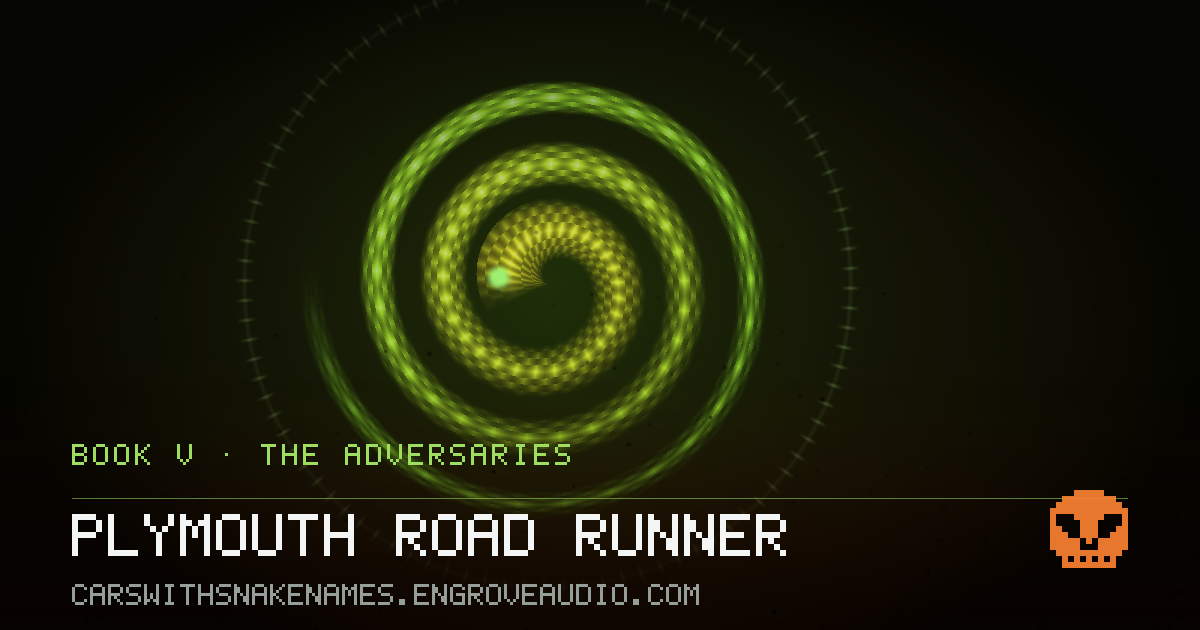
Sigil generated from the entry's own name. Every coil, hue and scale in this plate is a function of the string “plymouth-road-runner”, and of nothing else.
The greater roadrunner is a ground cuckoo, and it is one of the most alarming birds in North America.
It runs at speeds around twenty-five miles per hour. It kills rattlesnakes — properly, routinely — by seizing them behind the head, and then beating them against the ground or a rock until the skull fails. Sometimes two birds work together, one distracting while the other strikes. It eats lizards, scorpions, small mammals and other birds. It has been observed killing venomous prey substantially longer than itself.
Warner Bros. built a cartoon around it in which the bird is a serene, blameless victim of a coyote’s ingenuity, and everyone in the world under the age of eighty now believes the roadrunner is fundamentally harmless.
And this is how it entered the Ophidiary. In 1968 Plymouth wanted a cheap, fast, unadorned muscle car for buyers priced out of the GTX. It licensed the cartoon — fifty thousand dollars, plus a further sum for the right to reproduce the “beep beep” as a horn note, which Chrysler engineers duly built — put bench seats and rubber flooring in a Belvedere body, fitted a 383 as standard and made a 426 Hemi available, and sold vastly more than it expected.
So the sequence runs: a bird that beats snakes to death on rocks, becomes a cartoon that beats no one, becomes a horn, becomes a badge on the cheapest fast car in America. Four steps from predation to a decal.
The Ophidiary’s note is simply this: of every adversary in Book V, the roadrunner is the one that actually does it. The mongoose is famous for a fight it usually wins. Apollo is a myth. The owl is opportunistic. But somewhere in the Sonoran desert, right now, a bird with a cartoon licensing history is holding a rattlesnake by the neck and swinging.
It holds the snake behind the head and swings it at the rock and swings it at the rock and then it is lunch. They made a horn out of this.
Questions people actually ask
Do roadrunners really kill snakes?
Yes. The greater roadrunner regularly preys on rattlesnakes, seizing them behind the head and battering them against rocks or the ground. Cooperative hunting between two birds has been documented.
How much did Plymouth pay for the Road Runner name?
Reported at USD 50,000 to Warner Bros. for the name and likeness, plus around USD 10,000 for the right to imitate the “beep beep” call, which Chrysler engineered into a purpose-built horn.
Provenance of claims
This is a satire with a research habit. Every load-bearing statement above is listed here and labelled, so you can tell which sentences would survive a librarian.
-
Documented
Chrysler paid Warner Bros. USD 50,000 for the Road Runner name and a further sum for the horn.
The figures are consistently reported at 50,000 and 10,000 respectively.
-
Documented
Greater roadrunners hunt and kill rattlesnakes, often by striking them against hard surfaces.
-
Documented
The Road Runner launched in 1968 with a 383 V8 standard and the 426 Hemi optional.